

Designing Travel Tech for Real Operations
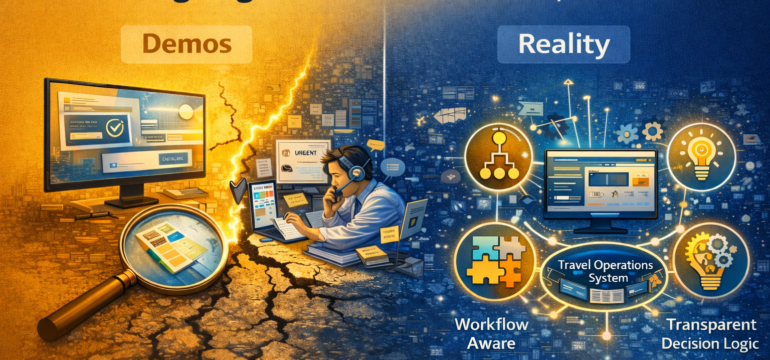
Most travel technology looks impressive in demos. Screens are clean, flows are smooth, and everything seems fast.
But once the system meets real operations — suppliers, agents, customers, exceptions — cracks begin to show.
This gap exists because most travel technology is designed to sell, not to operate.
WHY REAL OPERATIONS ARE MESSY BY NATURE
Travel operations are not linear.
They involve changes, cancellations, supplier delays, pricing mismatches, and human judgment.
Real systems must handle:
• Exceptions, not just ideal flows
• Human decision points
• Operational pressure during peak demand
DESIGNING FOR OPERATIONS, NOT JUST USERS
Good travel tech design starts from the inside.
Before thinking about UI, systems must understand workflows.
Operational-first design asks:
• Who handles this booking next?
• What happens if something breaks?
• How does the system guide decisions?
WHY FEATURE-LED DESIGN FAILS
Many platforms chase feature parity.
They add dashboards, filters, and toggles without improving operations.
This leads to complexity without clarity.
More features, more confusion.
SYSTEM THINKING OVER TOOL THINKING
Operational platforms are systems, not tools.
They coordinate people, processes, and data.
System thinking prioritizes:
• Flow
• Control
• Visibility
• Accountability
THE ROLE OF AUTOMATION IN OPERATIONAL DESIGN
Automation should remove friction, not flexibility.
Well-designed automation supports humans instead of replacing them.
Smart workflows allow intervention where needed and speed where possible.
WHAT REAL-WORLD READY TRAVEL TECH LOOKS LIKE
• Workflow-aware
• Exception-friendly
• Modular and adaptable
• Transparent in decision logic
CONCLUSION: OPERATIONS DEFINE VALUE
The true value of travel technology is revealed during operational stress.
Systems designed for real operations quietly perform when it matters most.


There are no comments