

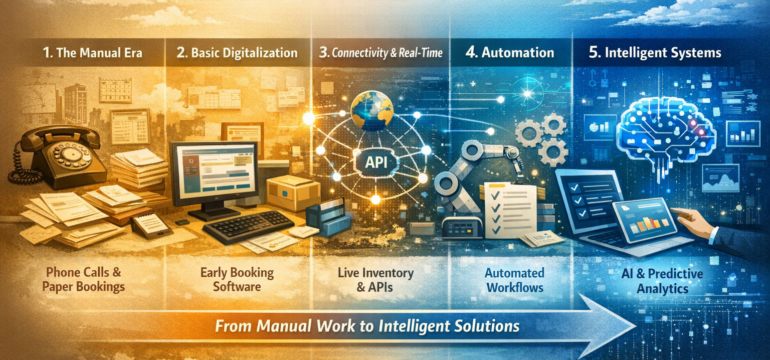
Evolution of Travel Technology: From Manual to Intelligent
Not very long ago, running a travel business meant phones ringing all day, inboxes overflowing, and teams manually stitching together itineraries.
Success depended more on people’s memory and relationships than on systems. This worked — until it didn’t.
As travel volumes increased, destinations expanded, and customers demanded instant responses, the old ways began to crack.
This is the story of how travel technology evolved, and why automation is no longer optional.
PHASE 1: THE MANUAL ERA – PEOPLE RAN THE BUSINESS
In the early days, travel operations were almost entirely manual.
Bookings were confirmed via phone calls and emails. Prices were updated manually. Availability lived in spreadsheets.
The system relied on experience, not scalability.
Growth meant hiring more people, not improving capability.
PHASE 2: BASIC DIGITALIZATION – SOFTWARE ENTERS THE SCENE
The first wave of travel technology introduced basic booking tools and accounting software.
These systems digitized records but did not change how work was done.
Manual intervention remained high.
Systems were isolated.
Data lived in silos.
Technology existed, but intelligence did not.
PHASE 3: CONNECTIVITY AND REAL-TIME EXPECTATIONS
As customers began expecting instant confirmations and live pricing, connectivity became critical.
APIs allowed systems to talk to each other.
Real-time inventory replaced static data.
This phase marked a shift from record-keeping to operational enablement.
PHASE 4: AUTOMATION – REDUCING HUMAN DEPENDENCY
Automation fundamentally changed travel operations.
Tasks that once consumed hours could now be completed in seconds.
Automated confirmations, pricing updates, reporting, and workflows reduced errors and improved speed.
Teams shifted from execution to oversight.
PHASE 5: INTELLIGENT SYSTEMS – TECHNOLOGY THAT THINKS
Modern travel technology is no longer reactive.
It anticipates demand, highlights bottlenecks, and supports decision-making.
Data analytics, workflow intelligence, and system-driven controls define this era.
WHAT THIS EVOLUTION MEANS FOR TRAVEL BUSINESSES TODAY
Travel companies today face a choice:
Operate with people-heavy systems or build technology-driven operations.
Those who adapt gain resilience, scalability, and control.
Those who don’t struggle to compete.
CONCLUSION: THE JOURNEY IS STILL CONTINUING
Travel technology is still evolving.
The businesses that succeed are those that evolve with it — thoughtfully, strategically, and with a clear understanding of how work should truly be done.

There are no comments