


Why Most Travel Businesses Fail to Scale
Many travel businesses experience growth, but very few achieve true scalability.
Growth increases revenue; scalability increases capability. In the travel industry, this distinction determines whether a company survives long-term or collapses under its own operational weight.
Over the last decade, demand for travel has expanded rapidly. However, the operational models of many travel businesses have not evolved at the same pace. As a result, increased bookings often expose systemic weaknesses rather than creating sustainable momentum.
This article explains why most travel business scalability is failing and how technology, when designed correctly, resolves these structural limitations.
THE SCALABILITY FAILURE FRAMEWORK
Travel businesses fail to scale due to a breakdown across three foundational pillars:
1. People
2. Process
3. Platform
Scaling fails when one or more of these pillars cannot support increased volume, complexity, or speed.
PEOPLE: HUMAN-DEPENDENT OPERATIONS
Most travel companies rely heavily on manual coordination:
• Booking confirmations
• Supplier follow-ups
• Pricing checks
• Invoice reconciliation
As booking volume grows, human dependency creates delays, inconsistencies, and burnout. Hiring more staff temporarily masks the problem but increases costs and reduces margins.
PROCESS: UNSTRUCTURED WORKFLOWS
Processes in many travel businesses evolve organically rather than strategically.
Manual exceptions become standard practice. Knowledge remains undocumented. Decision-making depends on individuals instead of systems.
This creates operational fragility. When key people leave or demand spikes, the system breaks.
PLATFORM: FRAGMENTED TECHNOLOGY STACKS
Many travel businesses use multiple disconnected tools:
• CRM
• Accounting software
• Booking portals
• Email-based coordination
Without a unified technology backbone, data silos form and operational visibility disappears.
WHY TRAVEL IS UNIQUELY HARD TO SCALE
Unlike other industries, travel combines:
• Dynamic pricing
• Multiple suppliers
• Inventory volatility
• Time-sensitive fulfillment
• Customer service dependency
Each booking is a coordinated transaction involving multiple stakeholders. Without automation and system intelligence, complexity increases exponentially.
HOW TECHNOLOGY FIXES THE SCALABILITY PROBLEM
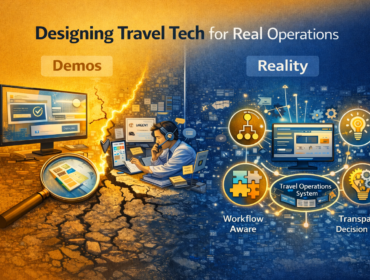
Centralized platforms replace fragmented tools with unified control.
Automation removes repetitive tasks.
APIs ensure real-time inventory and pricing accuracy.
Technology transforms scaling from manual expansion into system-driven growth.
AUTOMATION AS A STRATEGIC ADVANTAGE
Automation is not about replacing people; it is about eliminating operational friction.
Automated workflows:
• Reduce errors
• Increase speed
• Improve customer experience
• Protect margins
DATA VISIBILITY AND DECISION INTELLIGENCE
Scalable travel businesses operate with real-time insights.
Data enables forecasting, demand planning, and performance optimization.
BUILDING FUTURE-READY TRAVEL OPERATIONS
True scalability requires:
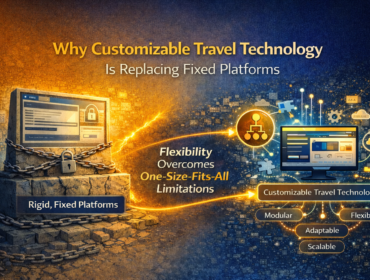
• Modular systems
• Customizable workflows
• API-first architecture
• Automation-driven operations
Technology becomes the foundation, not an add-on.
SCALE IS A SYSTEM, NOT A STRATEGY
Travel businesses that fail to scale are not underperforming — they are under-equipped.
Those that invest in intelligent technology build resilient, scalable, and future-ready operations.


There are no comments